Unleashing Inherent Reductive Capacity of MoS2 for Bromate Decontamination: Crucial Role of Iron or Edge Mo-Atom as Electron Shuttle
April 29, 2026
Junjie Li, Zhipeng Luo, Tianqi Ji, Huihuan Lian, Huabin Zeng
Separation and Purification Technology
https://www.sciencedirect.com/science/article/abs/pii/S1383586626015327
Published:28 April 2026
Abstract
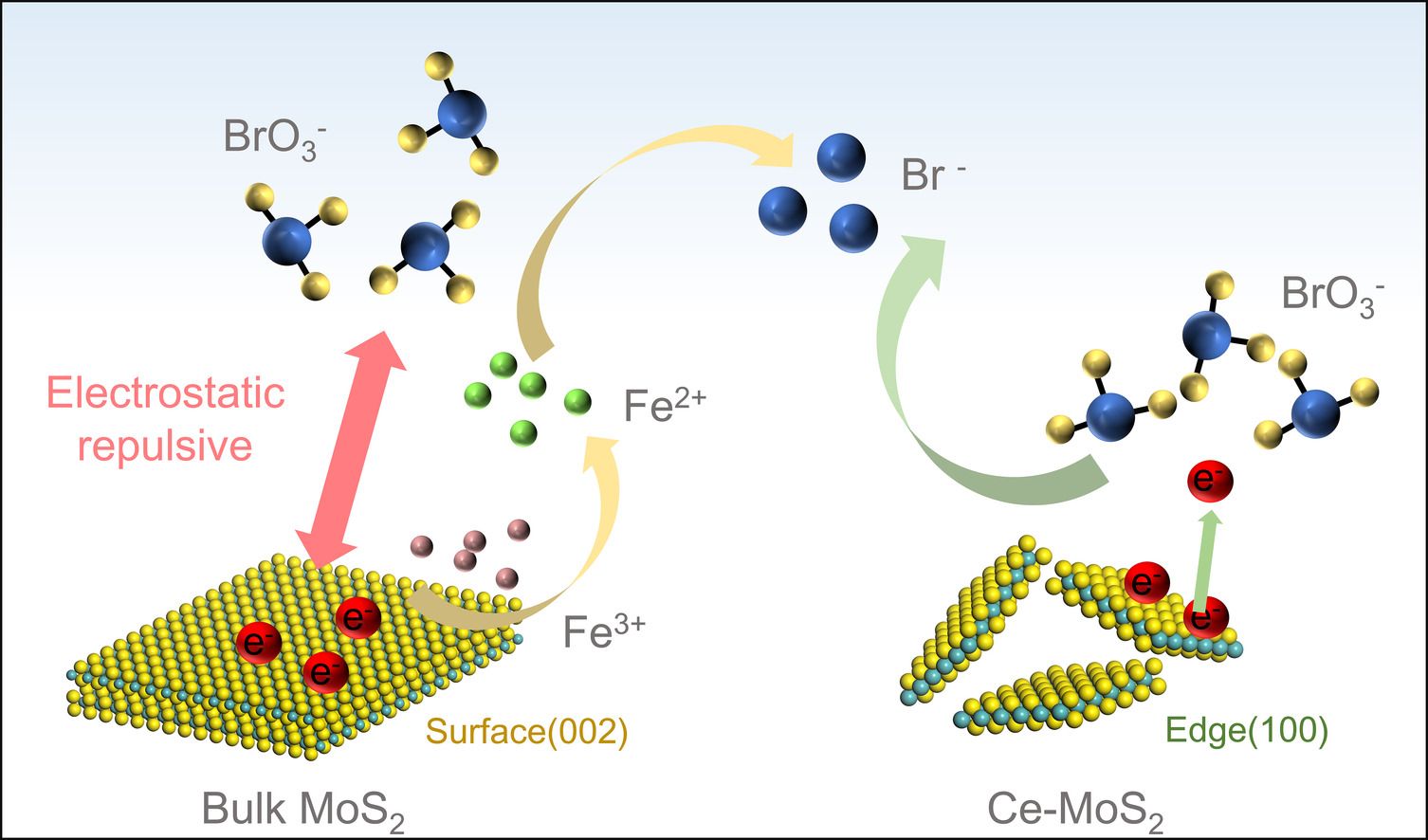
Molybdenum disulfide (MoS2) has emerged as a promising environmentally benign solid reductant to replace nanoscale zero-valent iron, benefiting from the low-valence states of both Mo and S species. However, existing research has predominantly focused on performance enhancement, while the fundamental mechanisms governing the unleashing of MoS2 reductive capacity remain poorly understood. Herein, using bromate (BrO3−) as a model contaminant—which, like the MoS2 surface, carries a negative charge, creating electrostatic repulsion that impedes interfacial electron transfer—we demonstrate that the introduction of Fe3+ can overcome this limitation. Serving as an electron shuttle to bridge MoS2 and the contaminant, Fe3+ captures electrons from the MoS2 surface to generate Fe2+, which subsequently transfers electrons to BrO3− to achieve its stepwise deoxygenation, with FeOH2+ identified as the dominant active species. More critically, the layered 1 T-MoS2 nanosheets (ce-MoS2) prepared by chemical lithium intercalation exhibit autonomous reductive capability independent of iron mediation, enabling complete reduction of BrO3− to Br− within 10 min. Density functional theory calculations reveal that the superior performance of ce-MoS2 stems from the high electrical conductivity endowed by the metallic electronic structure of the 1 T phase, as well as abundant active sites provided by coordinatively unsaturated Mo atoms exposed at the edges of nanosheets. This study systematically elucidates the dual mechanisms for unleashing MoS2 reductive capacity—iron-mediated indirect electron shuttling versus direct electron transfer at edge Mo sites—establishing a theoretical framework and optimization strategies for the rational design of MoS2-based materials.