Extreme plasticity in the photosystem composition of a low-light Prochlorococcus ecotype in response to iron and light
October 9, 2024
Xin Zhang, William G. Sunda, Haizheng Hong, Dalin Shi*
Limnology and Oceanography Letters
https://doi.org/10.1002/lol2.10441
Published: 28 September 2024
Abstract
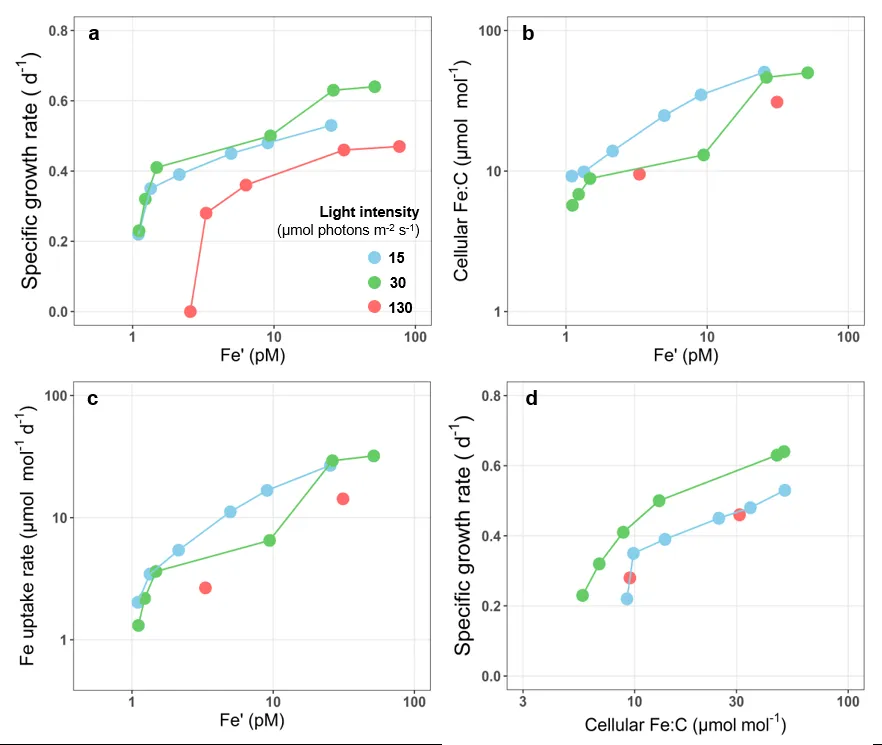
Light affects the cellular iron (Fe) requirement of phytoplankton because of its presence in major photosynthetic proteins. Thus, interactions between variable Fe concentrations and light intensities could restrict photosynthetic carbon fixation in the ocean. Here we show a narrowing of the optimal light range for growth of a marine cyanobacterium, Prochlorococcus strain NATL1A, a member of LLI ecotype, under Fe limitation. The response of the cells to variations in Fe and light involved differential changes in the cellular content of low-Fe photosystem II (PSII) and Fe-rich photosystem I (PSI), and associated up to 23-fold changes in PSII : PSI ratios, showing an unprecedented extreme plasticity of the photosynthetic apparatus. Our study demonstrated the physiological effects of Fe and light interactions on this low-light-adapted Prochlorococcus strain, and increases our understanding of the reasons for the wide distribution of this and possibly other Prochlorococcus strains in the ocean.