Kinetics-Controlled Secondary Grafting Regulates Charge and Pore Architecture in Polyamide Nanofiltration Membranes
June 30, 2026
Zhiying Li, Ruiqi Zheng, Sihan Li, Chenyang Wang, Yangying Zhao, Xin Yu, Xiaomao Wang
Environmental Science & Technology
https://doi.org/10.1021/acs.est.6c03988
Published: 22 June 2026
Abstract
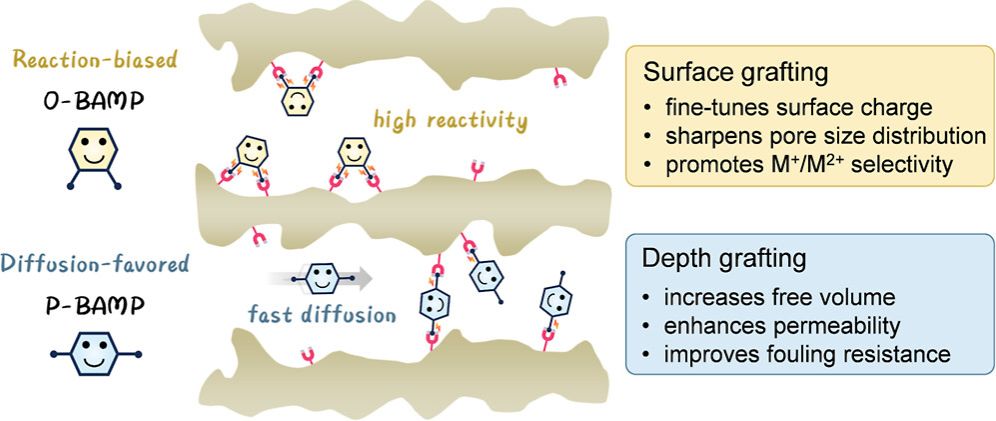
Precise nanofiltration requires control over the distributions of charge, pore architecture, and hydration environments throughout active layers with thickness of tens of nanometers, yet most postmodification strategies remain confined to the outermost surface. Here, we transform secondary grafting into a kinetics-controlled reaction-diffusion process that regulates the spatial distribution of functional groups within the polyamide (PA) matrix. Bis(aminomethyl)pyridinium (BAMP) isomers with systematically varied intrinsic reactivity and diffusivity were synthesized to control grafting localization. Highly reactive isomers undergo interfacial kinetic capture, enhancing surface charge and sharpening pore size distribution to achieve Li+/Mg2+ selectivity up to 67.4, desirable for lithium recovery from complex brines. In contrast, more diffusive but less reactive isomers penetrate the PA network prior to grafting, redistributing internal charge and increasing transport-effective free volume, yielding high water permeance (51.8 LMH/bar) together with strong SO42-/dye selectivity (108) and improved antifouling and antibacterial performance. Depth-resolved functionalization is confirmed experimentally and interpreted using density functional theory calculations, molecular dynamics simulations, and a grafting Damköhler framework that links molecular reactivity and diffusivity to spatial localization and membrane transport behavior. This work establishes a mechanistic strategy for controlling internal transport environments in nanofiltration membranes and offers a scalable approach for environmental separations, including brine resource recovery and treatment of diverse source waters and wastewaters.